优先队列就是会自动排序的队列;
头文件`#include ;
声明格式为:priority_queue ans;//声明一个名为ans的整形的优先队列`
基本操作有:
1
2
3
4
5
empty ( ) pop ( ) top ( ) push ( ) size ( )
默认的优先队列优先级高的排在前面,既优先级高的先出队列。
例如int型的优先队列数值大的排在前面、先出队列。
默认优先队列使用方法(优先级高先出队列): 1 2 3 4 5 6 7 8 9 10 11 12 13 14 15 16 17 18 19 20 21 22 23 24 25 26 #include <cstdio> #include <queue> using namespace std;int main () priority_queue<int > q1; if (!q1.empty ()) q1.top (); int n; scanf ("%d" ,&n); int t; for (int i=1 ;i<=n;i++) { scanf ("%d" ,&t); q1.push (t); } while (!q1.empty ()) { printf ("%d " ,q1.top ()); q1.pop (); } return 0 ; }
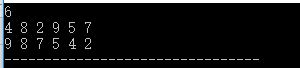
执行结果如下:
从大到小排序(优先级低的先出); 1 2 priority_queue<int ,vector<int >,greater<int > >q1;
1 2 3 4 5 6 7 8 9 10 11 12 13 14 15 16 17 18 19 20 21 22 23 24 25 26 #include <cstdio> #include <queue> using namespace std;int main () priority_queue<int ,vector<int >,greater<int > >q1; if (!q1.empty ()) q1.top (); int n; scanf ("%d" ,&n); int t; for (int i=1 ;i<=n;i++) { scanf ("%d" ,&t); q1.push (t); } while (!q1.empty ()) { printf ("%d " ,q1.top ()); q1.pop (); } return 0 ; }
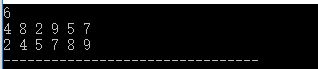
执行结果如下:
自定义排序: 1 2 3 4 5 6 7 8 9 10 11 12 13 14 15 16 17 18 19 20 21 22 23 24 25 26 27 28 29 30 31 32 33 34 35 36 37 38 39 40 41 42 43 44 45 46 47 48 49 50 51 52 53 54 55 56 57 58 59 60 61 62 63 #include <cstdio> #include <queue> using namespace std;int tmp[100 ];struct cmp1 { bool operator () (int x,int y) { return x>y; } }; struct cmp2 { bool operator () (const int x,const int y) { return tmp[x]>tmp[y]; } }; struct node { int x,y; friend bool operator <(node a,node b) { return a.x>b.x; } }; priority_queue<int >q1; priority_queue<int ,vector<int >,cmp1>q2; priority_queue<int ,vector<int >,cmp2>q3; priority_queue<node>q4; int main () int i,n; node a; while (~scanf ("%d" ,&n)) { for (i=0 ;i<n;i++) { scanf ("%d %d" ,&a.y,&a.x); q4.push (a); } printf ("\n" ); while (!q4.empty ()) { printf ("%d %d\n" ,q4.top ().y,q4.top ().x); q4.pop (); } printf ("\n" ); int t; for (i=0 ;i<n;i++) { scanf ("%d" ,&t); q2.push (t); } while (!q2.empty ()) { printf ("%d\n" ,q2.top ()); q2.pop (); } printf ("\n" ); } return 0 ; }
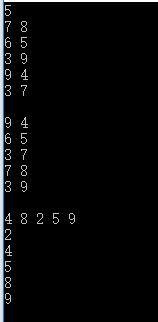
执行结果如下:
下面举个栗子: 题目链接
Stall Reservations Description Oh those picky N (1 <= N <= 50,000) cows! They are so picky that each one will only be milked over some precise time interval A…B (1 <= A <= B <= 1,000,000), which includes both times A and B. Obviously, FJ must create a reservation system to determine which stall each cow can be assigned for her milking time. Of course, no cow will share such a private moment with other cows. Help FJ by determining: The minimum number of stalls required in the barn so that each cow can have her private milking period An assignment of cows to these stalls over time Many answers are correct for each test dataset; a program will grade your answer.
Line 1: A single integer, N Lines 2…N+1: Line i+1 describes cow i’s milking interval with two space-separated integers.
Output Line 1: The minimum number of stalls the barn must have. Lines 2…N+1: Line i+1 describes the stall to which cow i will be assigned for her milking period.
5 1 10 2 4 3 6 5 8 4 7
Sample Output 4 1 2 3 2 4
题意:
思路
AC代码 1 2 3 4 5 6 7 8 9 10 11 12 13 14 15 16 17 18 19 20 21 22 23 24 25 26 27 28 29 30 31 32 33 34 35 36 37 38 39 40 41 42 43 44 45 46 47 48 49 50 51 52 53 54 55 56 57 58 59 60 61 62 63 64 65 66 67 #include <cstdio> #include <algorithm> #include <queue> using namespace std;const int Maxn=5e4 +5 ;typedef struct node { int b,e,stall,id; friend bool operator < (node n1,node n2) { return n1.e > n2.e; } } cow; cow s[Maxn]; bool cmp1 (cow x,cow y) return x.b < y.b; } bool cmp2 (cow x,cow y) return x.id < y.id; } int main () int N; while (~scanf ("%d" ,&N)) { for (int i = 0 ; i < N; i++) { scanf ("%d%d" ,&s[i].b,&s[i].e); s[i].id = i; } sort (s,s+N,cmp1); priority_queue<cow> que; s[0 ].stall = 1 ; que.push (s[0 ]); int cnt = 1 ; for (int i = 1 ; i < N; i++) { cow temp = que.top (); if (s[i].b <= temp.e) { cnt++; s[i].stall = cnt; que.push (s[i]); } else { s[i].stall = temp.stall; que.pop (); que.push (s[i]); } } sort (s,s+N,cmp2); printf ("%d\n" ,cnt); for (int i = 0 ; i < N; i++) printf ("%d\n" ,s[i].stall); } return 0 ; }